Double Frontage, Single Asset: The New Pricing Logic at Bond Street's Crossroads
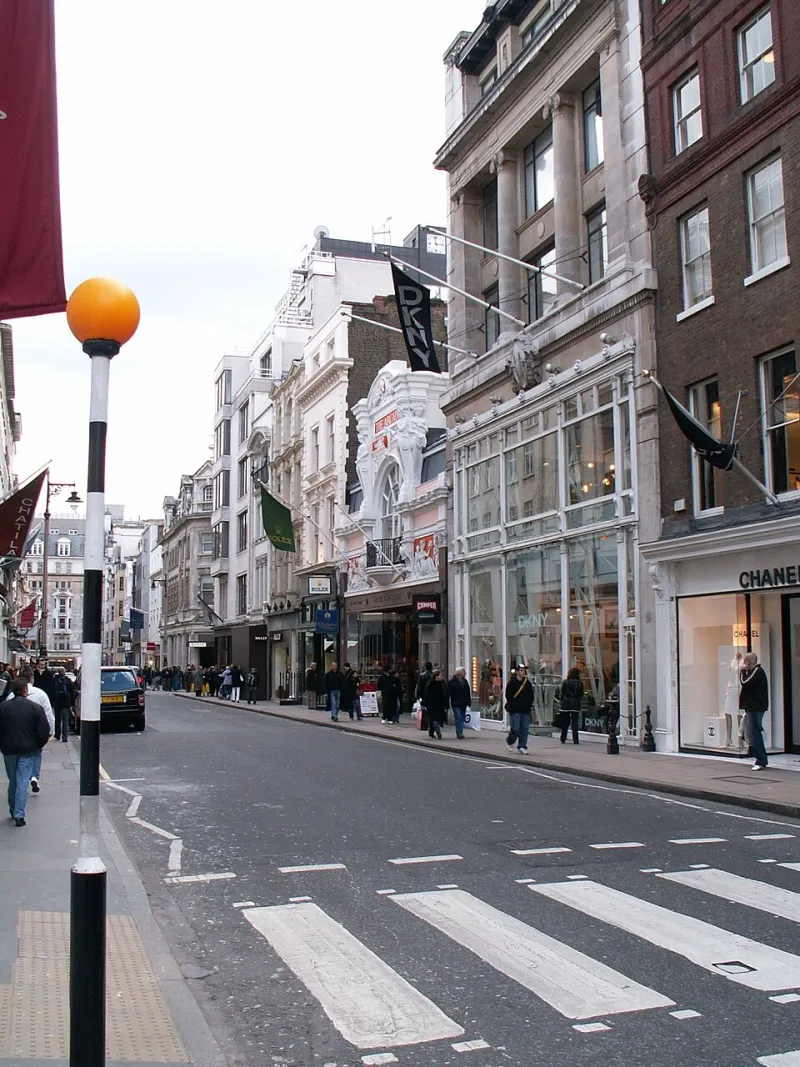
Photo: Unknown, CC BY-SA 3.0, via Wikimedia Commons
The corner unit has always carried a certain romance in prime London retail. It offers two ways in, two ways to be seen, and a natural stage for a brand that wants to be noticed without shouting. But romance is not a valuation methodology. What has changed in 2026 is that the corner is no longer priced as a charming anomaly. At a handful of junctions along New Bond Street, it is being priced as an asset with its own logic, its own comparables and its own rent multiple.
Where the premium is being written
The addresses that matter are not difficult to identify. New Bond Street's meeting points with Brook Street, Burlington Gardens and Piccadilly each produce a different kind of corner. The Brook Street junction sits within the watch and jewellery quarter, where dual aspect allows a tenant to face the main artery while catching the approach from the side street. Burlington Gardens brings a cultural and gallery-adjacent footfall, with the Royal Academy's presence shaping the rhythm of the day. Piccadilly, meanwhile, captures transport-driven movement and a tourist gaze that is less seasonal than it once was.
Agents active on the street report that the gap between corner and mid-block rents has widened over the past eighteen months. A Zone A rent of £1,050 to £1,150 per sq ft remains a plausible mid-block benchmark for good-quality secondary frontage in the northern stretches. At the best corners, quotes are now being tested at £1,350 to £1,500 per sq ft, with the upper end reserved for sites that combine return frontage, clear signage rights and a service entrance that does not compromise the shopfront. These are not universal figures, and the spread between individual corners is almost as wide as the spread between corner and mid-block. But the direction of travel is clear.
Why two frontages change the arithmetic
The premium is not simply a matter of extra glass. A corner site offers a landlord and a tenant a set of optionalities that a mid-block unit cannot replicate. The first is display. A brand can run two distinct window narratives — one for the main street, one for the approach — without dividing the interior. The second is access. A single entrance can serve the retail floor while a second, discreet door supports private appointments, click-and-collect or servicing. For categories such as fine jewellery, watches and wellness, where the consultation is part of the product, that flexibility is worth paying for.
The third is sightline. A corner is visible from two directions at once, which matters in a street where the pedestrian flow is not evenly distributed. The fourth is signage. A corner elevation offers the possibility of a projecting sign, a fascia on two elevations, or a more sculptural treatment that would be refused on a mid-block terrace. In a market where frontage is increasingly understood as a media asset, that visibility has a value that can be modelled.
The comparables problem
Valuers have long used zoning and ITZA to strip a unit back to its retail core, but the corner has always sat awkwardly within those conventions. A return frontage is not the same as a second main frontage, and the quality of the side street matters enormously. Brook Street is not Burlington Gardens, and Burlington Gardens is not Piccadilly. The result is that a simple corner allowance — traditionally somewhere between 5 and 15 per cent — now looks too blunt for the top end of the market.
Market participants are beginning to price corners on a more granular basis. Frontage length, the number of active elevations, the depth of the side-street approach, the presence of a service door and the ability to secure advertising consent are all being treated as value drivers in their own right. That is a more sophisticated approach, but it also makes the landlord's job harder. A corner unit cannot be benchmarked against the unit next door. It has to be benchmarked against other corners, and there are only a handful of those.
What it means for landlords in 2026
The practical consequence is that landlords with corner holdings are being forced to make decisions earlier in the leasing cycle. The first is reconfiguration. In some cases, the premium justifies combining a corner unit with an adjacent mid-block space to create a larger dual-aspect flagship. In others, it justifies the opposite: separating a long corner frontage into two smaller units, each with its own entrance, to capture two tenants at a higher combined rent. Both strategies carry risk. The first reduces the pool of potential occupiers; the second can dilute the quality of the corner if the subdivision is poorly executed.
The second decision concerns signage. A corner is a branding opportunity, but it is also subject to the estate's management scheme and the local planning authority's advertising policies. Landlords who invest in a coherent signage strategy — one that treats the corner as a single composition rather than two unrelated fascias — are finding that tenants will pay for the clarity. Those who leave it to the tenant to negotiate consent are discovering that the premium erodes in the detail.
The third decision is tenant mix. The corner premium is not evenly distributed across categories. Watch and jewellery occupiers, wellness operators and international leather goods houses have shown the strongest appetite for dual frontage. Fashion flagships remain interested, but they are more sensitive to floorplate size and ceiling heights. Food and beverage operators value the corner for its visibility, but their rental bids are constrained by turnover expectations. A landlord who overprices a corner for the wrong category will find that the unit sits vacant while the mid-block space next door lets.
The selective premium
It would be wrong to describe the corner premium as a rising tide. It is a selective repricing, driven by a small number of sites that combine the right frontage, the right adjacencies and the right level of investment. The best corners are now being treated as distinct assets with their own lease structures, their own service-charge allocations and, in some cases, their own turnover-rent mechanics. The weaker corners — those with a narrow return frontage, a compromised service arrangement or a side street with limited footfall — are still priced close to mid-block comparables.
For landlords, the lesson of 2026 is that the corner is not a generic uplift. It is a specific asset class that rewards careful analysis and punishes lazy benchmarking. As Bond Street's rental map continues to redraw itself around the Elizabeth Line entrances and the cross-street flows they have created, the junction unit will be priced on its own terms. The corner premium is real, but it belongs only to the corners that earn it.