Day of Rest, Test of Confidence: Sunday Trading on Bond Street
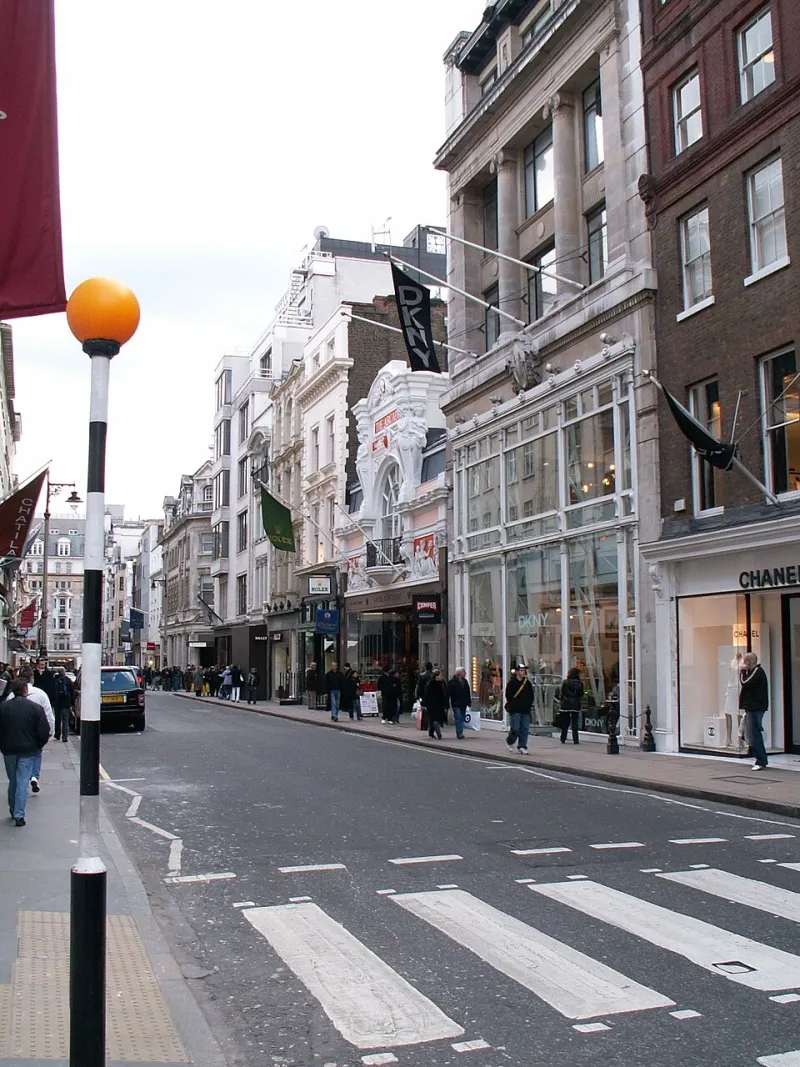
Photo: Unknown, CC BY-SA 3.0, via Wikimedia Commons
On a Sunday morning in November, Bond Street is rarely silent, but it is frequently half-lit. A stretch of New Bond Street may show a fully staffed salon, its doors open at eleven; a few paces on, a flagship remains shuttered behind a polished grille, windows dressed but lights low. The contrast is not new. What has changed in 2026 is how much weight landlords, investors and neighbouring occupiers now place on that contrast. In a market where headline rents have become a blunt instrument, the decision to open — or to stay dark — is emerging as a sharper gauge of luxury demand.
The Legal Frame Is Only Half the Story
England's Sunday Trading Act 1994 restricts shops over 280 square metres to six continuous hours of Sunday opening. Many Bond Street flagships sit above that threshold; some boutiques fall below it and can trade freely. The law therefore sets a perimeter, not a strategy. Within it, brands choose between a compressed six-hour day, an appointment-only regime, or no Sunday trade at all. Those choices are shaped by wage premiums, rotas, security, cleaning, climate control and the expected conversion of weekend footfall. They are also shaped by confidence.
A Frontage-Level Reading
An audit of frontages — not a formal survey, but the kind of observation available to anyone walking the street — shows three broad Sunday types. First, the fully open flagship: lights, music, several associates, a security presence and a doorman. Second, the soft-open boutique: doors open but staff levels reduced, often with a private-client appointment book doing the heavy lifting. Third, the dark frontage: windows lit, shutters down, no visible staff. The third category is the most misunderstood. A closed door can signal a fit-out, a private event, a staffing shortage or a deliberate margin decision. It does not automatically signal weak demand. But a cluster of dark frontages over successive weekends does tell the street something about the rhythm of trade.
Footfall Is Not Conversion
Transport data and pedestrian counts can flatter a weekend. Bond Street station entries rise on Saturdays and Sundays, but luxury conversion depends on intent, dwell time and the composition of the crowd. Sunday footfall includes leisure visitors, hotel guests, local residents and tourists whose spending is concentrated in hospitality and experience. An open store can capture that dwell time; a closed one redirects it. Cafés, hotels and galleries nearby notice the difference. For landlords, the relevant signal is not raw footfall but the ratio of open doors to passing traffic — a crude measure, but a revealing one.
The Appointment Economy
A growing number of Bond Street brands treat Sunday as a private-client day rather than a public trading day. The shutters may be down, but the salon is staffed, the coffee is out and the appointment book is full. This complicates any frontage-level audit, because visible darkness is not the same as commercial inactivity. It also complicates the landlord's view. A tenant that opens by appointment only is still bearing staffing and security costs, still using the premises and still signalling commitment to the location. The better question is not whether the door is open to the street, but whether the space is productive on the days it is occupied.
The Staffing Arithmetic
Sunday trading is expensive. Premium pay, rest-day rules, agency cover, additional security and the fixed costs of lighting and climate control all weigh on the incremental sales line. In a tight London labour market, a brand may conclude that a six-hour Sunday does not cover its cost of opening. That is a rational margin call, not necessarily a verdict on demand. Yet in prime luxury the store is also media: a window, a threshold, a physical statement. The open door is marketing. The closed door is a message too, and nearby occupiers read it.
What Investors Should Watch
For investors and leasing agents, Sunday opening is a leading indicator worth tracking alongside rent-free periods and incentive packages. A tenant that opens seven days is signalling commitment to the location, its staff and its covenant. A tenant that stays dark may be managing costs, but repeated darkness can affect service charge recovery, security arrangements and the street's perceived vitality. Where turnover rents apply, Sunday sales matter directly to the landlord's income. Landlords should be cautious about treating Sunday hours as a covenant issue; the better approach is to understand the operational rationale and to watch clusters rather than individual frontages.
The Week Re-negotiated
As 2026 draws to a close, the seven-day week on Bond Street is not a default. It is a negotiated position between brand, landlord, staff and customer. The Sunday shutter is therefore more than a shutter. It is a disclosure — imperfect, partial, but useful. For those who value prime London property through the lens of occupation rather than headline rent, the weekend rhythm is now part of the valuation story.