The Twin Thresholds: How Bond Street's Two Elizabeth Line Entrances Are Creating Parallel Prime Markets
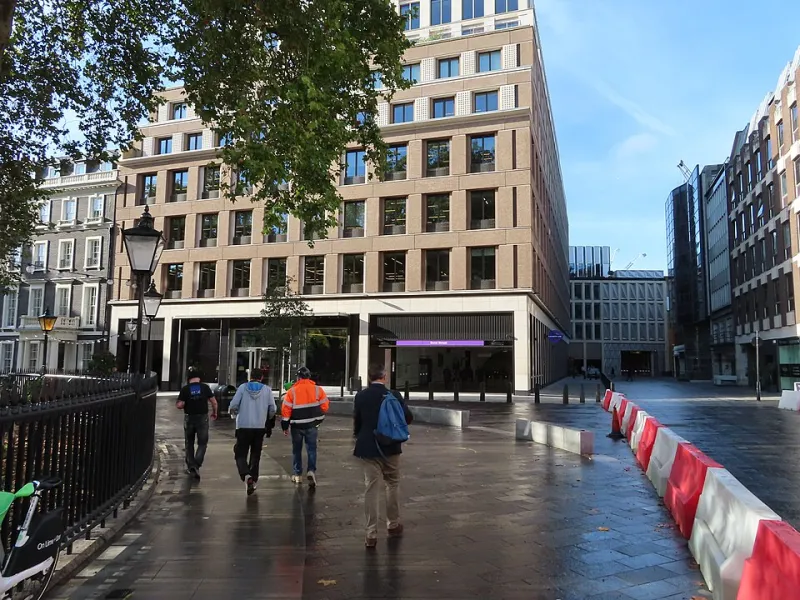
Photo: David Hawgood , CC BY-SA 2.0, via Wikimedia Commons
For most of its history, Bond Street was understood as a single proposition: a spine of luxury retail running north from Piccadilly, priced and marketed as one address. The Elizabeth line disrupted that assumption less through the volume of passengers it delivered than through the geography of how it delivered them. With two separate ticket halls — one at Hanover Square to the east, one at Davies Street to the west — the station effectively installed a second front door on a street that had only ever needed one.
Four years on from the line's central section opening, the consequences are legible in the investment market. What has emerged is not a single Bond Street with a station attached, but two adjacent prime markets with different footfall profiles, different occupational demand and, increasingly, different valuation logic. Understanding which is which has become one of the more useful analytical exercises available to anyone underwriting Mayfair property in 2026.
A station with two front doors
The Hanover Square entrance sits at the retail heart of the district, discharging passengers directly into the New Bond Street and Brook Street pitch, with Oxford Street and Regent Street within a short walk. The Davies Street entrance, by contrast, opens toward Berkeley Square, Mount Street and the quieter western reaches of Mayfair, where the occupier mix is weighted toward private offices, galleries, residential and the discretionary service trades that accompany them.
That asymmetry was always going to matter. The mistake, common in the early commentary, was to treat the western entrance as simply a second, less convenient way into the same shopping district. In practice it has functioned as a gateway to a different district altogether — one whose economy runs on affluence rather than volume, and whose property market rewards a different kind of tenant and a different kind of lease.
Hanover Square: volume, velocity and visibility
The eastern hall has become the primary conduit for visitor footfall. Its catchment is broader, more transient and more heavily weighted toward discretionary shopping trips, and the retail market around it has priced accordingly. Zone A rents on the core pitches remain the benchmark against which all prime London retail is judged, and the competition for flagship space has not softened.
For landlords, however, the eastern market carries a corollary that is easy to overlook in strong years. High footfall is not the same as high conversion, and the pitches that sit a street or two back from the main run do not inherit the station's dividend automatically. Brook Street and Maddox Street have benefited where the occupational offer matches the arriving customer; secondary positions have remained exposed to the same void risk and incentive pressure that has characterised prime retail elsewhere in the capital. The eastern micro-market is generous to the well-located and unforgiving to the nearly-located.
Davies Street: discretion, dwelling and the office revival
The western hall tells a different story. Footfall here is lighter and more predictable, shaped by residents, office occupiers and destination-led visits rather than by browsing. That has supported a rental market less dependent on headline turnover and more dependent on covenant quality and lease length.
The most significant effect has been on the upper floors. The Davies Street catchment has strengthened the case for Mayfair office space at a moment when demand from family offices, boutique advisers and wealth managers has been quietly firming. Buildings that once struggled to let above the ground floor now support a layered income profile — retail or gallery at street level, offices above, residential at the top — that valuers are increasingly willing to underwrite as a coherent whole rather than as a set of awkward compromises.
Mount Street, Carlos Place and the streets around Grosvenor Square sit at the centre of this shift. They offer the discretion that a certain class of occupier now prizes, combined with genuine transport connectivity that was absent before the line opened. That combination is scarce, and it is being reflected in demand for smaller lot sizes that institutional capital has historically overlooked.
How valuers are splitting the comparables
The practical consequence for the investment market is a slow but discernible change in how comparables are assembled. A transaction on Old Bond Street no longer sets an automatic benchmark for a building off Berkeley Square, and valuers are increasingly explicit about which ticket hall a property is served by.
This is not a trivial adjustment. It affects yield assumptions, rent-review expectations and the length of the incentive package a landlord should budget for. Assets in the Hanover Square orbit are valued on the strength of the retail pitch and the durability of the flagship covenant; assets in the Davies Street orbit are valued on income diversity and the resilience of the occupational mix. Blending the two into a single Bond Street narrative now looks like a modelling error rather than a simplification.
The landlord's calculus
For owners, the strategic question is less about which side of the station is superior than about which side their building is genuinely suited to. A period building with generous floor-to-ceiling heights and a wide frontage belongs in the eastern conversation, where visibility is the product being sold. A smaller, quieter building with good upper-floor light and a residential consent belongs in the western one, where the occupier is buying discretion and the lease is likely to be longer.
Where landlords have struggled is in attempting to import eastern pricing logic into western stock. Aspirational quoting rents on streets that the station serves only indirectly have tended to produce extended marketing periods rather than improved outcomes.
Which addresses capture the long-term dividend
The addresses best placed to benefit are those that combine proximity to a ticket hall with an occupational identity that matches the passengers it delivers. In the east, that means the established luxury core and the better secondary streets immediately behind it. In the west, it means Mount Street and its hinterland, the Berkeley Square perimeter and the upper floors of buildings that can offer modern office specification within a conservation context.
The dividend, in other words, is not distributed evenly along the street. It accrues to buildings that understand which of Bond Street's two markets they actually address — and price themselves accordingly.